Abstract
The octopus offers one of the most useful biological counterexamples to the assumption that intelligence requires a single centralized controller operating a rigid body. Its nervous system is divided among a central brain, large optic lobes, and extensive neural circuitry embedded throughout eight flexible arms. Local arm circuits perform sensorimotor integration, coordinate suckers and musculature, and reduce the amount of raw information that must reach the central brain. Yet the animal remains a unified organism: central structures set goals, guide visually directed action, support learning, and coordinate behavior across the body. This combination makes the octopus a powerful model for AI systems that must act through tools, robots, APIs, edge devices, or teams of specialized agents.
This paper develops four primary connections: embodied cognition and soft robotics; distributed control and edge AI; neuromorphic computing; and heterogeneous multi-agent systems. It then proposes an octopus-inspired agent architecture in which a central cognitive core establishes goals and constraints, specialized peripheral agents execute locally, reflex-like modules handle deterministic fast paths, and a peer coordination fabric allows lateral communication without routing every event through a master orchestrator. The paper also stress-tests the analogy. Octopus arms are not eight independent minds, neuromorphic computing is not uniquely derived from cephalopods, and biological decentralization does not remove the need for global coordination, memory consolidation, or safety controls. The strongest lesson is therefore not 'eliminate the brain.' It is 'centralize intent, decentralize execution, and design the body, communications fabric, and local policies as part of the intelligence itself.' Terminology note. The standard scientific plural is “octopuses.” “Octopi” is common but etymologically mixed. “Octopii” is not standard. This document uses “octopuses.”
1. Why the Octopus Is a Distinct Model of Intelligence
Most familiar AI metaphors begin with the brain and treat the body, tools, sensors, and execution environment as peripherals. The octopus reverses that ordering. Its flexible body creates an enormous control problem, and evolution solved that problem by distributing substantial sensing and processing into the arms themselves. More neurons are distributed across the arms than are located in the central brain, and the axial nerve cord of each arm contains repeated local structures associated with suckers and nearby musculature [1][2].
This matters for AI because contemporary agents increasingly operate outside a single model invocation. They use browsers, databases, code interpreters, financial systems, robots, cameras, enterprise software, and other agents. Once an AI system must perceive and act through many heterogeneous interfaces, its architecture begins to resemble a control system more than a chatbot. Latency, partial observability, communication costs, tool permissions, local failure, and coordination become first-class design problems.
The octopus is uniquely useful because it combines five properties rarely found together in one animal:
- A soft, continuously deformable body with extremely high effective degrees of freedom.
- Dense, multimodal sensing distributed across hundreds of suckers.
- Substantial local sensorimotor processing in the arms.
- A central brain that still performs learning, goal selection, visual guidance, and global coordination.
- Lateral pathways that can support communication across peripheral structures without requiring every signal to traverse the central brain.
The result is neither a classical centralized controller nor a collection of independent organisms. It is a hierarchical, partially decentralized, embodied control system. That intermediate form is precisely the design space that many agentic AI systems are now entering.
2. Biological Architecture: Central Brain, Peripheral Intelligence, and Soft Body
2.1 A nervous system divided across functional layers
The octopus nervous system is commonly described as comprising the central brain, optic lobes, and a large peripheral arm nervous system. Reviews estimate more than 500 million neurons in total, with roughly 350 million associated with peripheral ganglia and arm circuitry [1]. Exact counts vary by species and method, but the architectural point is robust: much of the nervous system is physically close to the sensors and actuators it controls.
Each arm contains an axial nerve cord, intramuscular nerve cords, and a ganglion associated with each sucker. Recent anatomical work found segmentation and repeated neural organization along the arm, a plausible biological strategy for controlling a continuous limb through locally repeated modules [2][3]. Other work identified nerve-cord pathways that connect arms and may provide alternative routes for inter-arm signaling [4].
2.2 Compression between local and global processing
One of the most important architectural facts is the disparity between the dense local circuitry of the arms and the much smaller number of long-range fibers connecting the periphery to the brain. Sivitilli, Smith, and Gire describe a system in which millions of local sensory and motor neurons are connected to the brain through a much narrower communication channel [1]. This creates a forced compression problem. Raw sensor data cannot all be forwarded centrally. Local circuitry must integrate, filter, habituate, and translate continuous physical signals into behaviorally useful events.
For AI, this is analogous to a system in which edge devices, tool adapters, or specialist agents process high-volume local state and report only exceptions, summaries, confidence changes, or requests for higher-level arbitration. The intelligence lies partly in what is not transmitted.
2.3 Local autonomy does not eliminate central control
Popular descriptions sometimes imply that each arm contains an independent brain. That is misleading. Peripheral circuits can generate and coordinate substantial local behavior, but experimental work also shows that the central brain is required for important forms of learning and trial-by-trial directional choice [5]. Octopuses can also use visual information to guide an arm toward a target, demonstrating integration between central visual processing and peripheral execution [6].
The accurate model is therefore hierarchical autonomy. The brain can specify an objective or behavioral program without micromanaging every muscle contraction. Local circuits implement the details, adapt to contact, and reduce the dimensionality of the control problem. Central and peripheral intelligence are complementary rather than competing.
2.4 Morphology performs computation
An octopus arm is a muscular hydrostat. It bends, elongates, shortens, twists, stiffens, and conforms without rigid joints. Because the body naturally deforms around objects and surfaces, some control complexity is absorbed by material mechanics. The body constrains possible motions, stores elastic energy, distributes force, and converts local contact into useful shape change. This is a concrete example of morphological computation: physical structure reduces the amount of explicit control computation required [7].
3. Four Research Categories
3.1 Embodied Cognition and Soft Robotics
The strongest and most direct octopus-to-AI connection is soft robotics. Conventional industrial robots use rigid links, discrete joints, accurate state estimation, and centralized trajectory control. They excel in structured environments but can be fragile or expensive to control in clutter, water, deformable spaces, or direct contact with people. Octopus-inspired robots instead use compliant materials, continuous deformation, distributed sensing, and contact-rich control.
Recent systems demonstrate the progression from imitation of arm shape to imitation of control architecture. A 2023 Science Robotics system integrated electronics and sensing into a soft octopus-like arm capable of reaching, grasping, and environmental interaction [8]. A 2025 system implemented hierarchical suction intelligence, coupling local sucker behavior with higher-level coordination [9]. A 2026 Nature Machine Intelligence paper presented a tendon-driven arm with sensors embedded in artificial suckers and a hierarchy that supports local reflexes plus global autonomous grasping [10].
The broader AI lesson is that a policy cannot be evaluated independently of the body through which it acts. A compliant gripper, structured API, well-designed user interface, or constrained execution environment can make a simpler controller outperform a more powerful model attached to a poorly designed action surface.
3.2 Distributed Control Architectures and Edge AI
The octopus provides a biological model for separating fast local control from slower global reasoning. At the periphery, reflex-like loops respond to contact and changing force. At higher levels, the system selects goals, recruits additional arms, integrates vision, and changes strategy. This resembles edge AI, where local devices or services perform inference close to the data source while a central service handles coordination, model updates, policy, and long-horizon planning.
The important distinction is not simply 'centralized versus decentralized.' The octopus suggests a hybrid architecture with different time scales and different information granularity. Fast loops should remain close to sensors and actuators. Slow loops should reason over compressed state. Only uncertainty, novelty, conflict, or policy exceptions should be escalated.
This architecture can reduce latency and bandwidth, but it introduces new systems risks: local models may drift, edge nodes may disagree, stale global policies may persist, and compressed summaries may omit information later found to be important. Edge intelligence research therefore emphasizes partitioning, security, trustworthiness, model placement, and resource constraints rather than decentralization for its own sake [11].
3.3 Neuromorphic Computing
Neuromorphic computing attempts to build computational systems that more closely resemble biological neural processing through event-driven computation, sparse activity, distributed state, and closer integration of memory with processing. These approaches can reduce the energy and bandwidth costs associated with repeatedly moving data between separate memory and compute units [12].
The octopus contributes a valuable systems-level perspective: neuromorphic design should not be limited to reproducing cortical neurons or spiking dynamics. It can also study how computation is spatially allocated across a body, how local circuits summarize sensory streams, how repeated modules coordinate, and how a narrow communication channel links peripheral and central processing.
However, the direct claim must be bounded. Modern neuromorphic chips are primarily inspired by general neuroscience and electronic device physics, not specifically by octopus anatomy. The octopus is best treated as an architectural research target for distributed sensorimotor computing, not as the established origin of compute-in-memory hardware.
3.4 Heterogeneous Agent Systems
An octopus can be modeled abstractly as a collection of specialized, partially autonomous control modules serving one organism. Arms share common goals and body-wide constraints, but each has local sensory access, local dynamics, and local control capability. This makes the animal a useful analogy for heterogeneous multi-agent systems in which agents have different tools, models, memories, permissions, and execution environments.
Current LLM multi-agent systems often rely on a central orchestrator that decomposes work, assigns roles, collects responses, and synthesizes a result. That design is easy to understand but creates a bottleneck and single point of failure. Decentralized designs can improve specialization and resilience, but often pay for it through communication overhead, duplicated work, conflict resolution, and weak global state. Research on multi-agent coordination increasingly treats hybrid hierarchical-decentralized organization as a promising direction [13][14].
The octopus suggests that the solution is not equal autonomy for every agent. Different layers should possess different authority. Peripheral agents should be free to resolve routine local conditions, but global goals, resource limits, identity, and safety constraints should remain coherent across the system.
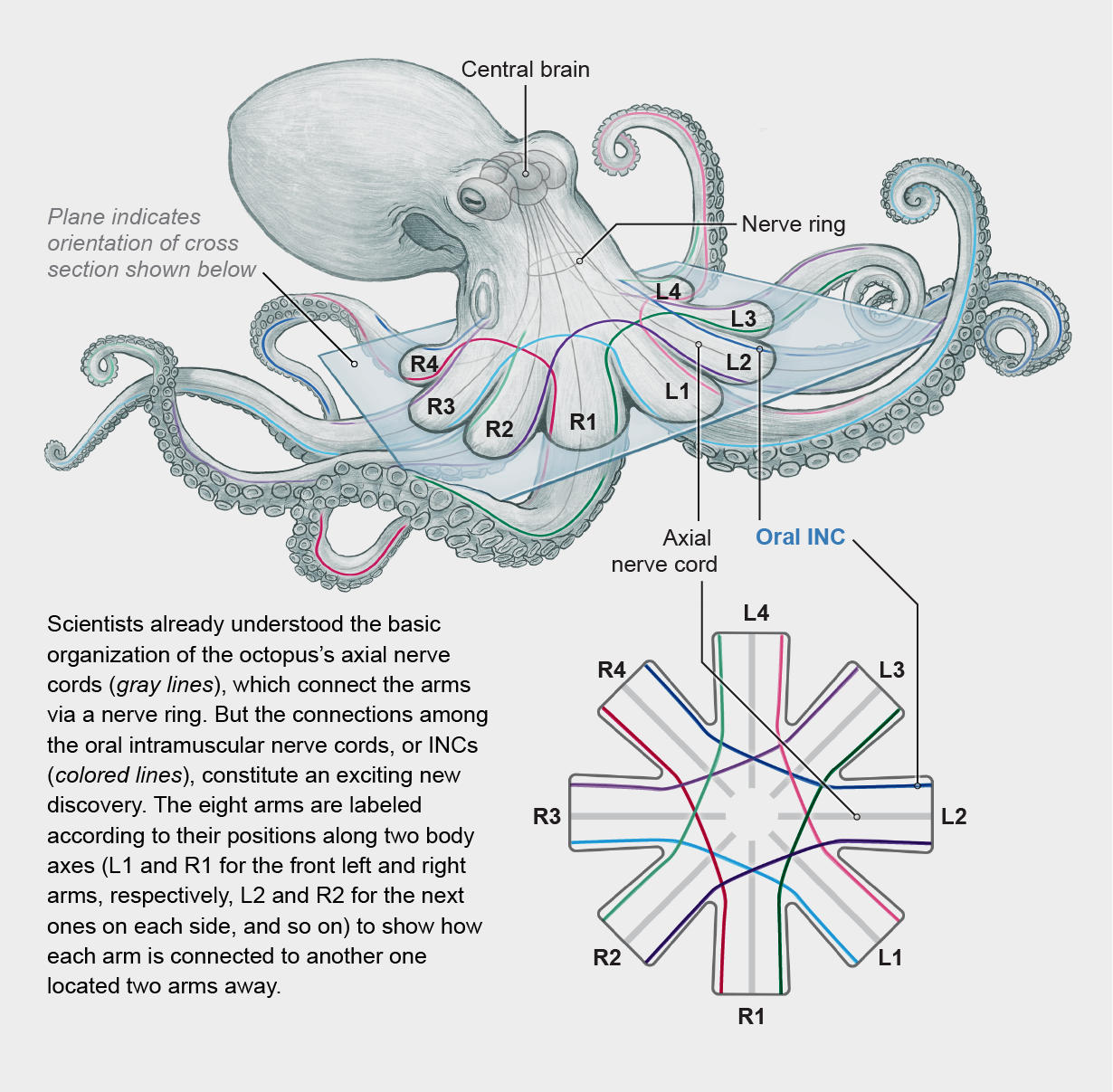
Figure 1. Octopus arm connectivity: axial nerve cords (gray) via the nerve ring, and oral intramuscular nerve cords (colored) that link each arm to another two positions away. This peripheral fabric is a biological precedent for lateral coordination without routing every signal through a central controller.
4. What Octopuses Teach Us About Agentic AI
4.1 Intelligence is a closed perception-action loop
A language model is not an agent merely because it can produce plans. Agency emerges when a system repeatedly observes state, selects an action, acts through an interface, receives consequences, updates memory, and changes future behavior. Octopus cognition is inseparable from this loop. Its suckers actively explore, touch, taste, adhere, and alter the sensory conditions from which the next decision is made.
4.2 Local processing should reduce global complexity
A central planner should not receive every token, sensor sample, log line, or tool event. Peripheral components should convert local streams into structured events such as 'contact established,' 'confidence fell below threshold,' 'position changed materially,' or 'policy conflict detected.' This reduces latency and makes global reasoning tractable.
4.3 Global intent and local execution should use different representations
The central system may reason in goals, constraints, budgets, and semantic state. Peripheral agents may operate in actuator commands, SQL queries, browser events, market orders, or deterministic state machines. Forcing every layer to share one representation wastes compute and creates brittle coupling.
4.4 Heterogeneity is a feature, not a defect
Eight equivalent general-purpose agents are not necessarily better than one. The useful pattern is specialized agents with distinct sensors, tools, response times, permissions, and local memory. Coherence comes from shared goals and protocols rather than identical internal models.
4.5 Lateral communication can bypass the coordinator
Peripheral agents should sometimes communicate directly, particularly when one agent's output is another's local input. A database agent and a validation agent need not route every intermediate fact through a general planner. Direct channels reduce latency, but they must be observable, typed, permissioned, and subject to global constraints.
4.6 Fault tolerance should be graceful rather than absolute
A distributed body can continue functioning when one arm is occupied or impaired, although overall capability falls. Agent systems should similarly isolate failing specialists, degrade to safer modes, and preserve core functions rather than collapsing when a single tool, model, or service becomes unavailable.
4.7 Attention is partly a routing problem
The arm-brain bandwidth bottleneck implies that relevance must be selected before information reaches the global workspace. In agentic systems, retrieval, event filtering, anomaly detection, and escalation policies may matter as much as the reasoning quality of the central model.
5. Proposed Octopus-Inspired Agent Architecture
The following architecture translates the biological lessons into an implementable software design. It is not intended as a literal simulation of an octopus. It is a systems pattern for combining global reasoning with local autonomy.
Biological analogue
AI component
Primary responsibility
State retained
Escalation trigger
Central brain
Cognitive core
Goals, planning, policy, cross-domain synthesis
Global task state, long-term memory
Strategic uncertainty or conflict
Optic lobes
High-bandwidth perception services
Vision, document parsing, monitoring, scene interpretation
Perceptual summaries and embeddings
Novel object, anomaly, low confidence
Arm nervous system
Specialist agents
Domain execution using local tools and policies
Local working memory and tool state
Budget, permission, or coordination exception
Sucker ganglia
Reflex and validation modules
Fast deterministic checks and contact-level control
Minimal local state
Threshold breach or ambiguous state
Inter-arm pathways
Peer coordination fabric
Typed lateral messages and handoffs
Message provenance and short-lived context
Disagreement or repeated failed handoff
Muscular hydrostat
Action substrate
APIs, robots, browsers, databases, transaction systems
Environment-specific execution state
Unsafe or irreversible action
5.1 Execution cycle
The cognitive core issues a goal, constraints, resource budget, deadline, and required evidence standard.
A routing layer selects one or more specialist agents based on capability, locality, current load, and permissions.
Specialists execute locally and use deterministic reflex modules for validation, rate limits, schema checks, and safety gates.
Agents exchange typed lateral messages when direct coordination is cheaper than central escalation.
Only compressed state changes, unresolved ambiguity, policy conflicts, or irreversible-action requests return to the cognitive core.
The core updates global memory, reallocates resources, or changes strategy.
5.2 Safety architecture
Biological unity does not map automatically to software safety. Software agents may have conflicting objectives, untrusted prompts, compromised tools, or incentives absent from a single organism. An octopus-inspired architecture therefore needs stronger explicit controls than the biological system:
Capability-based permissions: each agent receives only the tools and actions required for its role.
Local deterministic guards: high-risk actions pass through non-LLM validators and transaction simulators.
Budget tokens: compute, API calls, financial value, and time are allocated explicitly and cannot be exceeded silently.
Typed messages and provenance: peer communication uses schemas, identities, timestamps, and audit logs.
Two-phase commitment for irreversible actions: preparation and simulation occur locally, but execution requires a separate authorization step.
Quarantine and graceful degradation: anomalous agents can be isolated without terminating the entire workflow.
Global invariants: safety, legal, and user constraints are enforced independently of local agent preference.
5.3 A skeptical engineer’s simpler alternative
Before adopting a distributed agent architecture, compare it with a single well-instrumented agent using deterministic tools and a workflow engine. Many proposed multi-agent systems merely redistribute prompts while increasing cost, latency, and failure surface. The octopus analogy becomes valuable only when the task genuinely contains local high-volume state, heterogeneous tools, different response-time requirements, or meaningful fault-isolation needs. If those conditions are absent, a centralized design is probably superior.
6. Stress-Testing the Analogy
The arms are not eight independent brains. Arm circuitry is extensive and locally capable, but the animal depends on central structures for important learning, visual guidance, strategy, and coordinated behavior. Describing the octopus as nine independent brains obscures the integration that makes the system work.
Biological decentralization does not imply software decentralization is always efficient. Neural tissue has continuous local feedback, shared metabolism, co-evolved interfaces, and a single organism-level fitness function. Software agents communicate through slow, lossy, adversarial, or expensive channels and may not share a stable objective.
Embodiment can simplify control, but it can also hide state. Soft bodies conform naturally, yet their exact shape and force distribution are difficult to estimate. In software, abstraction can similarly reduce planning burden while making failures harder to observe.
Neuromorphic computing is a broader field. Event-driven and compute-in-memory systems are not uniquely octopus-inspired. The defensible contribution is a new research emphasis on distributed sensorimotor allocation, repeated peripheral modules, and communication compression.
Emergent coordination is not automatically coherent. Local autonomy can produce duplication, deadlock, contradictory actions, resource races, and unsafe composition. Emergence is an outcome to measure, not a design specification.
Fault tolerance may reduce performance sharply. A system that continues operating after losing a specialist can still become dangerously incompetent. Graceful degradation requires explicit capability estimates and safe-mode thresholds.
The metaphor can become unfalsifiable. A useful bio-inspired model must generate testable predictions. It should specify which topology, message policy, local controller, or body design will outperform a baseline under measurable conditions.
7. Research Program and Evaluation Framework
7.1 Core experimental question
Under what conditions does hierarchical local autonomy outperform centralized orchestration after accounting for task success, latency, communication cost, compute cost, safety, and recovery from failure?
7.2 Benchmark design
A rigorous study should compare at least four architectures on the same tasks:
Centralized single agent: one model controls all tools and receives all state.
Central orchestrator plus specialists: the common manager-worker pattern.
Decentralized peer agents: no persistent central coordinator.
Octopus-inspired hierarchy: central intent, peripheral execution, reflex modules, and lateral communication.
7.3 Task families
Robotic manipulation in cluttered or deformable environments.
Enterprise incident response across logs, cloud systems, tickets, and communications.
Financial execution workflows requiring market data, risk checks, compliance, and order routing.
Scientific research agents combining retrieval, code, simulation, and evidence verification.
Cyber-physical monitoring with high-volume edge sensors and intermittent connectivity.
7.4 Metrics
Metric
What it measures
Why it matters
Task success
Correct completion under normal conditions
Baseline capability
End-to-end latency
Time from observation to effective action
Tests value of local fast paths
Communication volume
Bytes, tokens, or messages crossing layers
Measures compression benefit
Compute cost
Model calls, accelerator time, energy proxy
Prevents hidden efficiency losses
Fault recovery
Performance after tool, model, or agent failure
Tests graceful degradation
Coordination coherence
Contradictions, duplicate work, deadlocks
Captures multi-agent overhead
Safety violations
Unauthorized, irreversible, or policy-breaking actions
Tests control integrity
Calibration
Accuracy of confidence and escalation decisions
Determines when local autonomy is safe
Adaptation speed
Time to recover after environment change
Measures embodied/edge responsiveness
7.5 Falsifiable hypotheses
Local reflex modules will reduce median action latency and central message volume on high-frequency sensorimotor tasks.
Hierarchical systems will outperform fully decentralized systems when tasks require shared global constraints or scarce resource arbitration.
Peer-to-peer lateral communication will improve latency only when messages are typed, sparse, and locally relevant; unconstrained peer chat will increase cost and error.
Embodied or tool-specific specialists will outperform identical general agents when interfaces differ materially and local state is expensive to centralize.
Centralized systems will remain superior on short, low-state, low-latency-insensitive tasks.
The main benefit of octopus-inspired architecture will arise from information routing and execution locality, not from simply increasing the number of language-model agents.
7.6 Near-term prototype
A practical prototype can be built without a physical robot. Use an incident-response simulation with eight specialist agents: telemetry, logs, identity, networking, database, code, communications, and remediation. Each agent receives local tools and maintains local state. Deterministic validators act as sucker-level reflexes. A central cognitive core sets the incident objective and global constraints. Agents communicate laterally through a typed event bus, while only anomalies and strategic decisions are escalated. Compare this system with a single-agent baseline and a conventional manager-worker multi-agent baseline.
8. Conclusion
The octopus is uniquely suited to deepen our understanding of AI agents because it demonstrates a complete alternative architecture of intelligence. It possesses sophisticated behavior without placing all sensing, control, and representation in one central location. Its body reduces computational burden. Its peripheral nervous system performs local integration. Its central brain supplies learning, goals, visual guidance, and cross-body coordination. Its communication bottlenecks force compression. Its repeated but non-independent arms show how specialized modules can remain parts of one agent.
The most defensible engineering principle is therefore not radical decentralization. It is hierarchical embodiment: centralize intent and global invariants; decentralize routine execution; place computation near the state it controls; permit carefully structured lateral coordination; and treat sensors, tools, interfaces, and physical form as components of intelligence rather than passive peripherals.
This model is especially relevant as AI leaves the chat window and enters robots, browsers, financial systems, scientific workflows, enterprise software, and networks of other agents. At that point, the central question is no longer only how powerful the model is. It is how the entire organism is organized.
References
- [1] Sivitilli, D. M., Smith, J. R., & Gire, D. H. (2022). Lessons for Robotics From the Control Architecture of the Octopus. Frontiers in Robotics and AI, 9, 862391. https://doi.org/10.3389/frobt.2022.862391
- [2] Olson, C. S., Schulz, N. G., & Ragsdale, C. W. (2025). Neuronal segmentation in cephalopod arms. Nature Communications, 16, 443. https://doi.org/10.1038/s41467-024-55475-5
- [3] Winters-Bostwick, G. C., Giancola-Detmering, S. E., Bostwick, C. J., & Crook, R. J. (2024). Three-dimensional molecular atlas highlights spatial and neurochemical complexity in the axial nerve cord of octopus arms. Current Biology, 34(20), 4756–4766.e6. https://doi.org/10.1016/j.cub.2024.08.049
- [4] Kuuspalu, A., Cody, S., & Hale, M. E. (2022). Multiple nerve cords connect the arms of octopuses, providing alternative paths for inter-arm signaling. Current Biology, 32(24), 5415–5421. https://doi.org/10.1016/j.cub.2022.11.007
- [5] Hooper, S. L. (2020). Operant Learning: Octopus Arms Need Brains to Learn Their Way. Current Biology, 30(21), R1301–R1304. https://doi.org/10.1016/j.cub.2020.09.004
- [6] Gutnick, T., Byrne, R. A., Hochner, B., & Kuba, M. (2011). Octopus vulgaris Uses Visual Information to Determine the Location of Its Arm. Current Biology, 21(6), 460–462. https://doi.org/10.1016/j.cub.2011.01.052
- [7] Hochner, B., Zullo, L., Shomrat, T., Levy, G., & Nesher, N. (2023). Embodied mechanisms of motor control in the octopus. Current Biology, 33(20), R1119–R1125. https://doi.org/10.1016/j.cub.2023.09.008
- [8] Xie, Z., et al. (2023). Octopus-inspired sensorized soft arm for environmental interaction. Science Robotics, 8(84), eadh7852. https://doi.org/10.1126/scirobotics.adh7852
- [9] Yue, T., Lu, C., Tang, K., et al. (2025). Embodying soft robots with octopus-inspired hierarchical suction intelligence. Science Robotics, 10(102), eadr4264. https://doi.org/10.1126/scirobotics.adr4264
- [10] Del Dottore, E., Adhami, R., Shahabi, E., et al. (2026). Peripheral control enabled by distributed sensing in an octopus-inspired soft robotic arm for autonomous underwater grasping. Nature Machine Intelligence, 8(5), 708–721. https://doi.org/10.1038/s42256-026-01230-y
- [11] Friha, O., Ferrag, M. A., Kantarci, B., Cakmak, B., Ozgun, A., & Ghoualmi-Zine, N. (2024). LLM-Based Edge Intelligence: A Comprehensive Survey on Architectures, Applications, Security and Trustworthiness. IEEE Open Journal of the Communications Society, 5, 5799–5856. https://doi.org/10.1109/OJCOMS.2024.3456549
- [12] Schuman, C. D., Kulkarni, S. R., Parsa, M., Mitchell, J. P., Date, P., & Kay, B. (2022). Opportunities for neuromorphic computing algorithms and applications. Nature Computational Science, 2, 10–19. https://doi.org/10.1038/s43588-021-00184-y
- [13] Sun, L., Yang, Y., Duan, Q., et al. (2025). Multi-Agent Coordination across Diverse Applications: A Survey. arXiv preprint arXiv:2502.14743. https://arxiv.org/abs/2502.14743
- [14] Yang, Y., Chai, H., Shao, S., et al. (2025). AgentNet: Decentralized Evolutionary Coordination for LLM-based Multi-Agent Systems. arXiv preprint arXiv:2504.00587. https://arxiv.org/abs/2504.00587 Source note. The biological and robotics sections rely primarily on peer-reviewed journal literature. The multi-agent references include recent preprints because the LLM-agent field is changing faster than conventional publication cycles. Claims derived from those sources should be treated as provisional until independently replicated.